1,435 mm between the inner faces of the two rails. It's the most widely used gauge in the world, covering most of Europe, North America, the Middle East, and China.
Rail Freight Reference
Rail Track Gauge Guide
In one sentence
Track gauge is the distance between the inner faces of a railway's two rails, and standard, narrow, and broad gauge each dominate different parts of the world for different reasons.
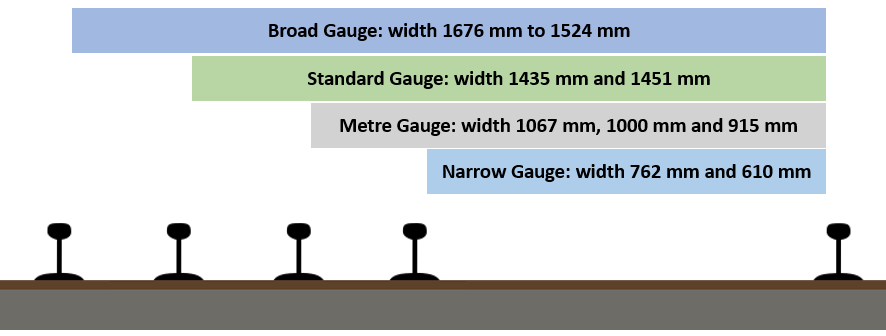
Standard gauge: the world's default
At 1,435 mm between the rails, standard gauge is the most widely used track gauge on the planet. It traces back to 1822 and the first public steam railway, and from there it spread across most of Europe, the Middle East, North America, large parts of Africa, and China. It's the default for passenger, regional, long-distance, freight, and high-speed rail alike.
Where does 1,435 mm come from?
The figure has older roots than the railway itself. It matches the spacing used on early English coal-mine tramroads, chosen so existing horse-drawn carts could keep running on the new rails without modification. Trace it back further and the same width is widely linked to the wheel spacing of Roman-era chariots — wide enough for two horses to stand side by side.
Britain formally fixed 1,435 mm as its standard gauge in 1846. As one illustration of how dominant it became: in Austria today, roughly 5,200 of the country's 5,575 km of rail network run on standard gauge, with the remaining 370-odd kilometres on narrow-gauge lines.
Narrow gauge: built for tight curves and steep terrain
Narrow gauge is anything tighter than standard. The most common versions are metre gauge (1,000 mm) and 760 mm gauge. It shows up in mountainous or difficult terrain, where a tighter gauge handles sharp curves and steep grades far better than standard gauge can — mountain and heritage railways across the Alps are a classic example.
Broad gauge: built for heavy, long-distance loads
Broad gauge is anything wider than 1,435 mm. The most common variant is Russian gauge at 1,520 mm, which is the second-largest rail network in the world by track length, after standard gauge. A wider gauge generally supports a heavier, more stable load, which is why broad gauge shows up on lines built for heavy freight over long distances — the Trans-Siberian network is the best-known example.
Why gauge still differs — and why it matters for freight
Most gauge differences date back to a time before any international coordination existed: railways were built independently, region by region, sized to the wishes of whoever was laying the track. In more than a few cases the mismatch was deliberate — a military or economic choice made specifically so a rival power or competing operator couldn't run its own rolling stock over your network.
The cost of that shows up as a "break of gauge": where two networks of different width meet, cargo either has to be transloaded onto different wagons, or the wagons themselves need their wheelsets exchanged or adjusted for the new gauge. Variable-gauge running gear has made that faster than it used to be, but it's still an extra step, and it still affects transit time on a route that crosses a gauge boundary.
New gauges are unlikely to appear going forward — the practical trend is expansion of the gauges already in place, with standard gauge in particular growing fast across East Asia.
FAQ
Frequently asked questions
Narrow gauge is anything under 1,435 mm — mainly metre gauge and 760 mm — and suits tight curves and steep terrain. Broad gauge is anything over 1,435 mm, most commonly Russian gauge at 1,520 mm, and suits heavy freight over long, mostly flat distances.
Most networks were built independently, before any international standard existed, and terrain, cost, and sometimes deliberate military or economic strategy all pushed different regions toward different widths.
The cargo either gets transloaded onto wagons built for the new gauge, or the same wagons have their wheelsets exchanged or adjusted at the border. Either way, it's an extra step that adds time to the route.
See the Wagon Types Built for Each Network
Rolling stock varies by gauge and by network just like the track itself. Browse our wagon reference for types, dimensions, and typical cargo.