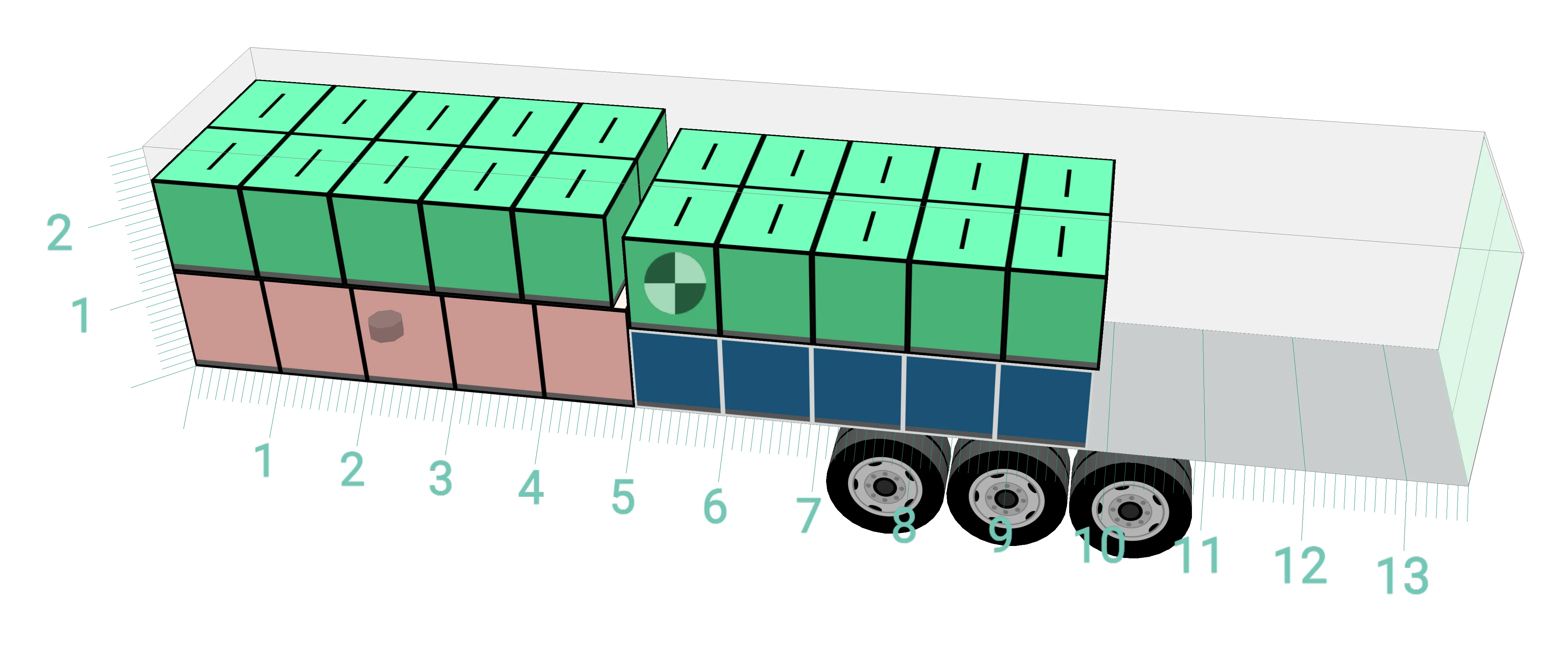
A standard European tautliner semi-trailer offers 13.6 loading metres over a nominal loading width of 2.40 m.
Road Freight Reference
Loading Meter (LDM)
In one sentence
A loading meter is one metre of trailer floor length across the full loading width - the unit road carriers use to price a shipment that's too long, too tall, or too fragile to stack.
Overview
The formula behind it is simple: take the shipment's footprint and divide by the trailer's usable width. LDM = (length × width) ÷ loading width, all in metres. A standard European tautliner is built around a 2.40 m loading width and 13.6 m of loading length - which is exactly where the familiar “13.6 LDM per trailer” figure comes from.
A Euro pallet (1.20 × 0.80 m) placed with its long side across the trailer takes up 0.80 × 1.20 ÷ 2.40 = 0.40 LDM. An industrial pallet (1.20 × 1.00 m) takes up 0.50 LDM. Both figures assume the pallet can't be stacked - a stackable pallet only consumes half that floor space, since a second one sits on top of it.
A kilogram-per-LDM ratio set in the tariff is what turns loading metres into a price. Rate grids built specifically around loading metres price a shipment like this directly, instead of forcing it through a weight-based tariff it doesn't really fit.
How do you calculate loading metres?
Multiply the footprint's length by its width in metres, then divide by the trailer's loading width of 2.40 m. A crate measuring 2.00 × 1.20 m works out to 2.00 × 1.20 ÷ 2.40 = 1.00 LDM. Add up the LDM of every non-stackable item to get the shipment total.
The calculation only ever looks at the floor, never the height - that's what separates it from volumetric weight. Applied item by item, using each piece's loaded footprint, it looks like this:
| Item | Footprint | Calculation | LDM |
|---|---|---|---|
| Euro pallet | 1.20 × 0.80 m | 0.96 / 2.40 | 0.40 |
| Industrial pallet | 1.20 × 1.00 m | 1.20 / 2.40 | 0.50 |
| Half pallet | 0.80 × 0.60 m | 0.48 / 2.40 | 0.20 |
| Long crate | 2.40 × 1.20 m | 2.88 / 2.40 | 1.20 |
Round in the direction the carrier can actually sell: a shipment that leaves 0.15 m of floor behind it unusable still consumes that space, which is why most tariffs round LDM up to the nearest 0.1.
How many loading metres is a pallet?
A non-stackable Euro pallet works out to 0.40 LDM and a non-stackable industrial pallet to 0.50 LDM, on a 2.40 m loading width. Declared stackable, each one consumes half that, since a second pallet is loaded on top.
Stackability changes the answer more than any other input, which is why it's worth confirming on the quote itself rather than assuming it.
| Pallet | Footprint | Non-stackable | Stackable |
|---|---|---|---|
| Euro (EPAL) | 1.20 × 0.80 m | 0.40 LDM | 0.20 LDM |
| Industrial | 1.20 × 1.00 m | 0.50 LDM | 0.25 LDM |
| Half (display) | 0.80 × 0.60 m | 0.20 LDM | 0.10 LDM |
Consistency matters more than precision here: a quote of 0.40 LDM per pallet and an invoice of 0.40 LDM per pallet never lead to a dispute. The disagreements come from a pallet declared stackable at booking and refused as non-stackable at the dock.
How do you convert loading metres into chargeable weight?
Multiply the loading metres by the kilogram-per-LDM ratio stated in the tariff. Under a tariff of 1,750 kg per LDM, a 1.2 LDM shipment has a weight equivalence of 2,100 kg - which becomes the chargeable weight if it's higher than the gross and volumetric figures.
That ratio is a commercial term set by the tariff, not a fixed industry constant, and it varies between carriers and services - always read it off the tariff in front of you, not from memory. Worked examples under a stated ratio of 1,750 kg/LDM:
| Shipment | LDM | Equivalence | Gross weight | Chargeable |
|---|---|---|---|---|
| 3 pallets, non-stackable | 1.20 | 2,100 kg | 900 kg | 2,100 kg |
| 3 pallets, stackable | 0.60 | 1,050 kg | 900 kg | 1,050 kg |
| 2 dense pallets | 0.80 | 1,400 kg | 1,900 kg | 1,900 kg |
A rate management system that holds this ratio per carrier can apply it automatically alongside the volumetric ratio and keep whichever of the two comes out higher, rather than it being recalculated by hand on every quote.
When is a shipment priced per loading metre instead of per kilo?
When floor space is the real constraint: non-stackable pallets, machinery, frames, doors and other long items. LDM tariffs also show up on part loads roughly between 4 and 13.6 LDM, where a weight bracket stops describing what's actually being sold.
Three situations tend to push a lane onto an LDM tariff. Non-stackable freight, where the height above it goes to waste. Part loads, where the buyer is effectively purchasing a section of trailer floor rather than a slot on a scale. And oversize items whose footprint doesn't map cleanly onto any weight bracket at all.
FAQ
Frequently asked questions
Only when it's non-stackable on a 2.40 m loading width. Declared stackable, it consumes 0.2 LDM instead, because a second pallet is loaded above it.
Whatever the tariff says. The kilogram-per-LDM ratio is a commercial term set by each carrier, not a fixed industry figure, so it has to be read off the tariff rather than assumed.
Yes - it's set per carrier, and often per service, in their own tariff. The same shipment can convert to a different chargeable weight depending on who's moving it, so it's worth confirming before comparing quotes.
Check the Pallet Footprints Behind These Numbers
Euro and industrial pallets drive most of the LDM math above. See full dimensions, weights, and regional standards in our pallet reference.