Reference
Mil Mi-26
The world's heaviest-lifting helicopter. Payload, cargo hold, door size and typical role below.
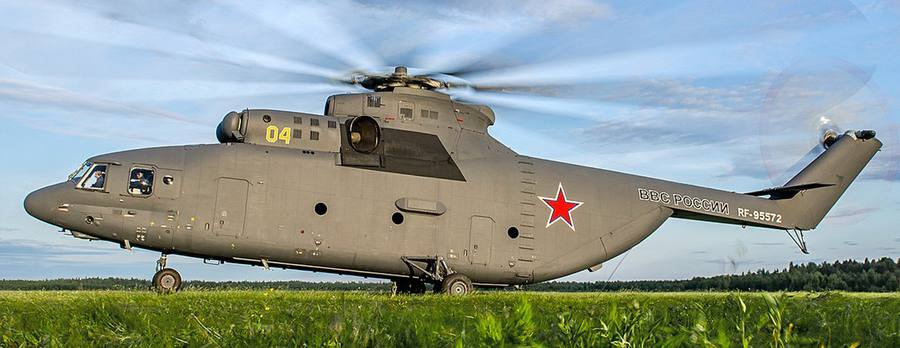
- Maximum payload
- 20,000 kg
- Cargo volume
- 110 m³
- Cargo hold (L × W × H)
- 12.00 × 3.20 × 3.10 m
- Cargo door
- 2.90 × 3.20 m
About the Mil Mi-26
The heaviest-lifting helicopter in service, carrying twenty tonnes either inside the cabin or beneath the fuselage on a sling.
It exists for loads that must reach a site with no runway and no road: drilling modules, transformers, bridge sections, recovered aircraft. The cabin is large enough to swallow vehicles, and the sling handles what will not fit inside.
What it carries
How it is built
- A cargo cabin with rear clamshell doors or a ramp, plus an external sling hook under the fuselage for loads that will not fit inside.
- A floor with tie-down rings rated for the cabin payload, and on the heavy types an internal winch.
- No requirement for a runway: the load is delivered to a prepared spot, a pad or a bare clearing.
Why it is used
- Delivers to sites with no airstrip at all, which is the entire reason for using one.
- Sling loading carries pieces that are too large for any cabin, placed precisely onto a foundation or structure.
- Routinely used for power-line construction, drilling support, mountain and offshore work, and disaster relief.
What to check before booking
- Payload and range are small against any fixed-wing freighter, and both fall sharply with altitude and temperature.
- Operating cost per tonne-kilometre is the highest in air cargo.
- Weather limits are tighter, and sling operations need clear ground and trained crews at both ends.
Track your air cargo
Follow an air waybill from acceptance to delivery with live status and ETAs across every major carrier.