
Reference
45' High-Cube
Largest box in mainstream service. Full internal dimensions, door opening, capacity and weights below.
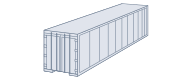
- Inside length
- 13.556 m
- Inside width
- 2.352 m
- Inside height
- 2.700 m
- Door width
- 2.340 m
- Door height
- 2.597 m
- Capacity
- 86 m³
- Tare weight
- 4800 kg
- Max cargo weight
- 27700 kg
About the 45' High-Cube
Combines high-cube internal height with five extra feet of length, giving the largest cargo volume of any ISO container in international ocean service.
For light palletised freight it offers among the lowest cost per pallet in the standard fleet, which is why it is favoured on trades where volume rather than weight decides the freight bill.
Availability is narrower than 20' and 40' equipment. Some ports, feeder vessels, rail services and road networks restrict 45' units, so the whole routing, inland legs included, should be confirmed before the booking is placed.
What it carries
How it is built
- A welded steel frame with corner castings at all eight corners, which take the crane spreader, the twistlocks that hold it to the deck and the lashings that secure it.
- Side walls and roof pressed from corrugated low-alloy weathering steel. The corrugation stiffens the panel, and the alloy forms a protective oxide layer instead of rusting through.
- Double doors at one end, closed by vertical locking bars with cam fittings that pull the door tight against the frame.
- A rubber gasket running the full perimeter of the door aperture, sealing against driven rain and dust.
- A floor of thick marine-grade plywood, usually film-faced, bolted onto steel cross-members that carry forklift wheel loads.
- Lashing points along the side rails and at floor level for securing cargo inside.
- Externally 2,896 mm (9 ft 6 in) tall against 2,591 mm (8 ft 6 in) for a standard container.
- Lashing rings rated to 1,000 kg are fitted on the front top-end rail, the bottom cross member and the corner posts.
- A recess in the floor at the front end seats the container on a gooseneck chassis, letting it ride lower and so stand taller.
- Many units carry corner castings at both 40 ft and 45 ft positions, so they can be handled with standard 40 ft equipment.
- Suits light, voluminous cargo and over-height pieces up to roughly 2.70 m.
Why it is used
- Running costs are low, with maintenance generally limited to panel dents, door seals and floor boards.
- Fully intermodal: the same sealed box moves by ship, rail and road without the cargo being rehandled at any interchange.
- Corner castings sit at ISO-standard positions, so any crane, spreader, chassis or railcar in the world can take it.
- Weatherproof and lockable, which limits both moisture damage and pilferage.
- The most widely available equipment there is, so a booking rarely fails for want of a box.
- The self-supporting, stackable frame also makes retired units useful for site storage and modular building.
Picked your box? Track it
Follow any container from load to discharge with live status and ETAs across ocean and air cargo.