
Reference
40' Open Top
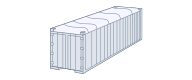
Top-loading at 40 feet. Full internal dimensions, door opening, capacity and weights below.
- Inside length
- 12.029 m
- Inside width
- 2.342 m
- Inside height
- 2.326 m
- Door width
- 2.341 m
- Door height
- 2.274 m
- Capacity
- 65 m³
- Tare weight
- 3810 kg
- Max cargo weight
- 26670 kg
About the 40' Open Top
The forty-foot open top, with the same removable roof bows and tarpaulin over a full-length steel frame.
The extra length suits long items that have to be craned in rather than driven in, such as lengths of pipe, structural profiles and sections of plant. The door header at one end can normally be removed too, so cargo can be fed in lengthways where crane access is awkward.
As with the 20', cargo above the roof line travels as over-height. It limits where the unit can be stowed on board, attracts a surcharge, and needs a lashing arrangement agreed before loading.
What it carries
How it is built
- The same steel frame and corrugated side walls as a dry box, but with no fixed roof.
- Removable roof bows spanning the width, carrying a tarpaulin that is roped down through eyelets along the top rails.
- A door header at one end that can usually be swung aside or lifted out, so long cargo can also be fed in lengthways.
- Corner castings and internal lashing points to the same standard as a closed container.
- Side walls are corrugated steel and the floor is wood.
- The roof is a set of removable bows carrying a tarpaulin, and the door header swings out of the way, so cargo can be lowered in from above or worked straight through the door opening by crane or grab.
- The roof bows are structural as well as holding the tarpaulin, so a flatrack remains the better choice for genuinely over-height cargo.
- Lashing rings rated to 1,000 kg are fitted in the upper and lower side rails and in the corner posts.
Why it is used
- Cargo can be lowered in vertically by crane when it is too heavy or too awkward to come through the doors.
- Cargo standing above the roof line can still travel, provided it is declared as over-height and properly secured.
- Footprint, stacking and handling are identical to a standard box, so it moves on normal equipment.
What to check before booking
- A tarpaulin is not a steel roof. It resists rain, but it is not a sealed or secure closure.
- Over-height cargo restricts where the unit can be stowed on board and normally attracts a surcharge.
Picked your box? Track it
Follow any container from load to discharge with live status and ETAs across ocean and air cargo.