
Reference
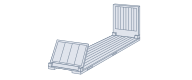
40' Flatrack Collapsible
Folding walls, 40-foot bed. Full internal dimensions, door opening, capacity and weights below.
- Inside length
- 11.660 m
- Inside width
- 2.200 m
- Inside height
- 2.245 m
- Door width
- Not applicable
- Door height
- Not applicable
- Capacity
- Not applicable
- Tare weight
- 5700 kg
- Max cargo weight
- 39300 kg
About the 40' Flatrack Collapsible
The forty-foot collapsible flatrack, with hinged end walls that fold flat for stacking when the unit runs empty.
It carries much the same cargo as the fixed-end 40' flatrack. The folding mechanism adds tare weight, so the payload rating sits a little below the fixed equivalent, which is worth checking when the cargo is close to the limit.
As with all flatracks the cargo is exposed, and the lashing arrangement is worked out per shipment rather than being standard.
What it carries
How it is built
- A steel deck on a reinforced underframe, rated to carry heavily concentrated point loads rather than an evenly spread one.
- End walls only, fixed on standard units and hinged on collapsible ones, with no side walls and no roof.
- Lashing rings set into the side rails, frequently with stanchion pockets for uprights.
- Corner castings at the standard ISO positions, so it handles and stacks like any other container.
- Hinged end walls fold inward onto the deck so empty units can be stacked for repositioning.
- A steel frame carrying a softwood floor, with end walls rated to take cargo securing and stacking loads.
- Lashing rings are set into the side rails, the corner posts and the floor, rated to 4,000 kg on 40 ft units.
- Gooseneck tunnels at both ends, with lashing winches and two-tonne belts on some units.
Why it is used
- Takes cargo wider and taller than any closed unit can accept.
- High payload rating, which suits dense cargo such as steel, stone and machinery.
- Can be loaded from the side or from above, so the door aperture never limits the piece size.
What to check before booking
- Cargo is fully exposed to weather and spray and usually needs wrapping or sheeting.
- Lashing and weight distribution must be worked out per shipment; over-width or over-height cargo also limits what can be stowed alongside.
Picked your box? Track it
Follow any container from load to discharge with live status and ETAs across ocean and air cargo.