
Reference
20' Open Top
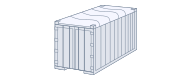
Removable tarpaulin roof. Full internal dimensions, door opening, capacity and weights below.
- Inside length
- 5.888 m
- Inside width
- 2.345 m
- Inside height
- 2.315 m
- Door width
- 2.286 m
- Door height
- 2.184 m
- Capacity
- 32 m³
- Tare weight
- 2250 kg
- Max cargo weight
- 30480 kg
About the 20' Open Top
Built on the same frame and side walls as a 20' standard, but the fixed steel roof is replaced by removable roof bows and a tarpaulin, so the box can be loaded from directly above.
That matters for cargo that cannot travel through the doors: a machine too heavy for a forklift, an assembly that has to be lowered onto its own mounting points, or a piece whose shape simply will not turn into a closed box.
Cargo may also stand above the roof line. It then travels as over-height, which has to be declared at booking, secured against the container's lashing points, and stowed where nothing sits on top of it.
What it carries
How it is built
- The same steel frame and corrugated side walls as a dry box, but with no fixed roof.
- Removable roof bows spanning the width, carrying a tarpaulin that is roped down through eyelets along the top rails.
- A door header at one end that can usually be swung aside or lifted out, so long cargo can also be fed in lengthways.
- Corner castings and internal lashing points to the same standard as a closed container.
- Side walls are corrugated steel and the floor is wood.
- The roof is a set of removable bows carrying a tarpaulin, and the door header swings out of the way, so cargo can be lowered in from above or worked straight through the door opening by crane or grab.
- The roof bows are structural as well as holding the tarpaulin. That is why a flatrack, which has no roof structure at all, is the better choice for genuinely over-height cargo.
- Lashing rings rated to 1,000 kg are fitted in the upper and lower side rails and in the corner posts.
Why it is used
- Cargo can be lowered in vertically by crane when it is too heavy or too awkward to come through the doors.
- Cargo standing above the roof line can still travel, provided it is declared as over-height and properly secured.
- Footprint, stacking and handling are identical to a standard box, so it moves on normal equipment.
What to check before booking
- A tarpaulin is not a steel roof. It resists rain, but it is not a sealed or secure closure.
- Over-height cargo restricts where the unit can be stowed on board and normally attracts a surcharge.
Picked your box? Track it
Follow any container from load to discharge with live status and ETAs across ocean and air cargo.