
Reference
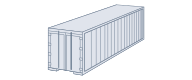
40' Standard
Twice the length, same cross-section. Full internal dimensions, door opening, capacity and weights below.
- Inside length
- 12.029 m
- Inside width
- 2.350 m
- Inside height
- 2.392 m
- Door width
- 2.340 m
- Door height
- 2.292 m
- Capacity
- 67 m³
- Tare weight
- 3780 kg
- Max cargo weight
- 26700 kg
About the 40' Standard
Shares the cross-section and the door aperture of the 20' standard at double the length, so anything that fits through one will fit through the other.
Volume roughly doubles while tare weight rises by only about seventy per cent, which makes it markedly cheaper per cubic metre for light, bulky cargo. The trade-off is payload: a 40' standard carries less weight than a 20', because the extra steel comes out of the cargo allowance.
It counts as two TEU and, with the high-cube build, accounts for most of the global fleet by capacity. In practice, road weight limits on the inland legs often bind before the container's own maximum does.
What it carries
How it is built
- A welded steel frame with corner castings at all eight corners, which take the crane spreader, the twistlocks that hold it to the deck and the lashings that secure it.
- Side walls and roof pressed from corrugated low-alloy weathering steel. The corrugation stiffens the panel, and the alloy forms a protective oxide layer instead of rusting through.
- Double doors at one end, closed by vertical locking bars with cam fittings that pull the door tight against the frame.
- A rubber gasket running the full perimeter of the door aperture, sealing against driven rain and dust.
- A floor of thick marine-grade plywood, usually film-faced, bolted onto steel cross-members that carry forklift wheel loads.
- Lashing points along the side rails and at floor level for securing cargo inside.
- Built in several door configurations: doors at one end, at both ends, or with additional doors along part or the whole length of one or both sides.
- Twenty and forty foot are the dominant lengths; smaller boxes are now rare, and the trend has run towards longer units such as the 45 ft.
Why it is used
- Running costs are low, with maintenance generally limited to panel dents, door seals and floor boards.
- Fully intermodal: the same sealed box moves by ship, rail and road without the cargo being rehandled at any interchange.
- Corner castings sit at ISO-standard positions, so any crane, spreader, chassis or railcar in the world can take it.
- Weatherproof and lockable, which limits both moisture damage and pilferage.
- The most widely available equipment there is, so a booking rarely fails for want of a box.
- The self-supporting, stackable frame also makes retired units useful for site storage and modular building.
Picked your box? Track it
Follow any container from load to discharge with live status and ETAs across ocean and air cargo.