
Reference
Containerships
Cellular ships for standard boxes. What it carries, how it is built and the limits that define the class.
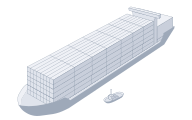
- Cargo gear
- Mostly gearless; smaller feeders may be geared
- Capacity measured in
- Twenty-foot equivalent units (TEU)
- Typical size
- From a few hundred TEU to over 24,000 TEU
- Cargo type
- ISO containers
About containerships
Ships built around one idea: that cargo travels in standard boxes which never need to be opened between shipper and consignee. Holds are fitted with vertical cell guides so containers drop into place, and more boxes are stacked on the hatch covers above.
Capacity is quoted in TEU, the twenty-foot equivalent unit. The range is enormous. Small feeders carry a few hundred, while the largest ships in service exceed 24,000 TEU on the Asia-Europe trade.
Containerisation is what made modern global supply chains economic. Port time fell from weeks to hours, pilferage collapsed, and the cost of moving manufactured goods dropped far enough to make long-distance sourcing viable.
What it carries
How it is built
- Cellular holds fitted with vertical cell guides, so containers drop into place and are located without loose lashing below deck.
- Hatch covers that double as the stacking surface for containers carried on deck, with lashing bridges and twistlocks securing the stacks.
- A hull form built for speed and for the torsional loads a wide open-topped structure has to carry.
- Reefer plugs on deck and in the holds so temperature-controlled units can be powered throughout the voyage.
Why it is used
- The cargo is already unitised, so port time is a fraction of what break-bulk handling would take.
- Standard boxes move between ship, rail and road without the goods being touched again.
- Very high capacity per voyage on the largest ships, which is what drives the low unit cost of containerised freight.
- Schedules are fixed and published, so shippers can plan against a liner timetable.
What to check before fixing
- The largest ships can only call at deepwater terminals with the right crane outreach.
- Stack weight and stability limits mean a ship rarely loads to both its full weight and its full slot capacity.
- Misdeclared cargo weight or contents is a persistent safety problem, and a known cause of stack collapse and fire.
Track the ship as well as the box
Follow any vessel and its schedule, with live position, port calls and ETAs across the world fleet.