
Reference
M-6 (118" H)
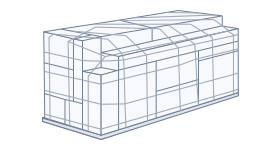
The tall M-6 build. Full IATA code, rate class, weights, volume and aircraft compatibility below.
- IATA ULD code
- PGA 10-ft high, 20-ft flat pallet with net
- Prefixes
- PGA, PGE, PGF, PSA, PSG, P7E, P7F, and P7G
- Rate class
- Type 1
- Aircraft compatibility
- 747 Combi, 777F; 747F through side cargo door only
- Maximum gross weight
- 11,340 kg (25,000 lb)
- Tare weight
- 500 kg (1,102 lb)
- AS1825 volume
- 39.6 m³ (1,400 ft³)
About the M-6 (118" H)
The tall build of the M-6, being the same twenty-foot PGA pallet squared off to 299.7 cm rather than 244 cm.
The extra height lifts volume from 33.7 m³ to 39.6 m³ at an unchanged 11,340 kg rating, which suits light bulky cargo. Note the loading restriction: on the 747F it can only go in through the side cargo door.
What it carries
How it is built
- A twenty-foot main-deck pallet, squared off to 299.7 cm (118 in) high. This is the tall build of the M-6.
- A flat aluminium sheet base with hardened edge rails that lock into the aircraft restraint system.
- Cargo built up on the base and held down by a net tensioned onto the edge rails.
- Contoured builds shape the load to the hold profile; squared-off builds use the full main-deck height instead.
- Wing variants add hinged or fixed-angle side extensions to carry cargo that overhangs the base.
Why it is used
- Takes cargo of almost any shape, since nothing encloses it.
- The lightest tare of any ULD for a given footprint, so more of the weight allowance goes to cargo.
- Stacks flat when empty, which keeps the cost of repositioning equipment down.
What to check before booking
- The cargo is exposed and the net is the only restraint, so the quality of the build-up decides whether the load arrives intact.
- The finished load has to match the hold contour or it will not fit.
- Nets and edge rails wear, and both are inspected before the unit is accepted.
Track your air cargo
Follow an air waybill from acceptance to delivery with live status and ETAs across every major carrier.