
Reference
LD-3 Reefer
The pharma cold-chain workhorse. Full IATA code, rate class, weights, volume and aircraft compatibility below.
- IATA ULD code
- RKN contoured cool container
- Prefixes
- RVN
- Rate class
- Type 8
- Door opening
- 137 x 140 cm (54 x 55 in)
- Aircraft compatibility
- 747, 767, 777, 787, DC-10, MD-11 lower hold
- Maximum gross weight
- 1,588 kg (3,500 lb)
- Tare weight
- 210 kg (463 lb)
- AS1825 volume
- 4.5 m³ (159 ft³)
About the LD-3 Reefer
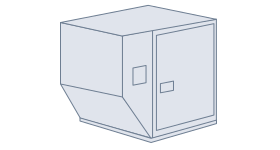
The refrigerated LD-3, built to the RKN code with insulated walls and a solid sealing door. Most examples are forkable.
This is the unit most temperature-controlled air freight moves in, and the default for pharmaceutical shipments. The cost of that capability is weight: tare rises from around 82 kg on a dry LD-3 to 210 kg here, against an unchanged 1,588 kg gross rating, so usable payload falls accordingly.
What it carries
How it is built
- Half-width insulated lower-hold unit with one angled end.
- The door is solid, sealing the insulated envelope.
- Most examples are forkable.
- Insulated panel walls, usually foam-cored, built onto a standard container base.
- A solid door with a sealing gasket in place of the canvas curtain used on dry units.
- Active units carry their own refrigeration machinery with battery or aircraft power; passive units hold temperature using stored coolant.
- Temperature monitoring throughout, and on active units a controller showing setpoint against actual.
Why it is used
- Holds a temperature range across the whole journey, including ground handling and tarmac waits, which is where an unprotected cold chain usually breaks.
- Uses the same aircraft positions and handling equipment as the equivalent dry unit.
- The standard choice for pharmaceuticals, vaccines and high-value perishables, where a temperature excursion destroys the cargo's value.
What to check before booking
- Insulation and machinery both eat internal volume compared with the dry equivalent.
- Tare weight is markedly higher, so revenue payload is lower.
- Active units need power or charging on the ground, and pre-cooling before the cargo goes in.
Track your air cargo
Follow an air waybill from acceptance to delivery with live status and ETAs across every major carrier.