
It depends heavily on the route, anywhere from a few days for short regional hops to 30-40 days for long-haul routes like Shanghai to Rotterdam. Enter your actual origin and destination to get a route-specific estimate rather than a general rule of thumb.
Web App
How long will your shipment actually take?
Enter an origin and destination to see a realistic transit time, based on how shipments actually move on that route instead of the number printed on a carrier's schedule.
How It Works
From two ports to a realistic ETA
-

Select route
Pick your origin and destination ports.
-

Add cargo details
Specify the container type and sailing date.
-

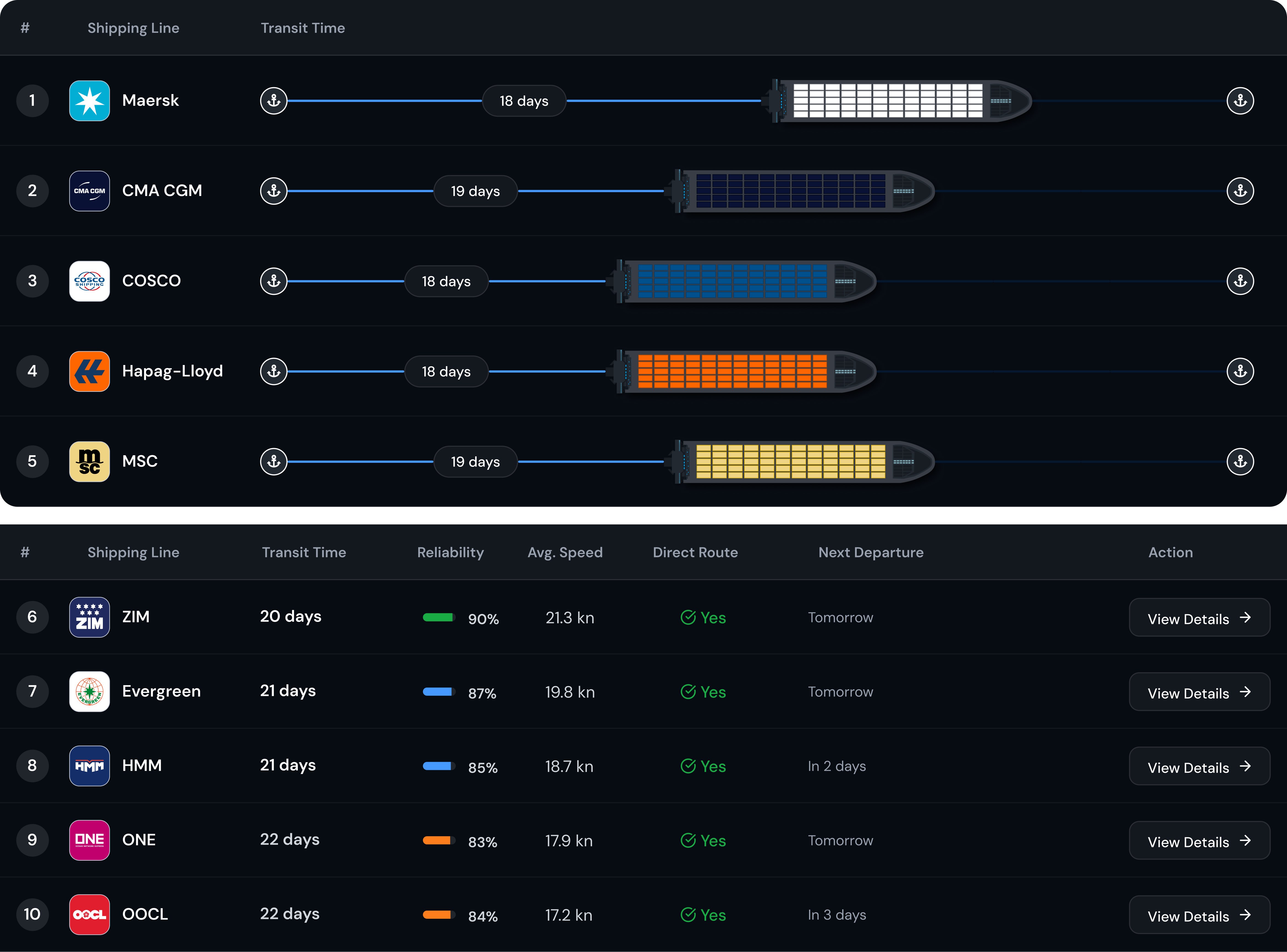
Compare carriers
See how different shipping lines actually perform on that route.
-

Plan with confidence
Book around a transit time that reflects reality, not a best case.
What It's Based On
Built on real movement, not published schedules
A carrier's schedule shows what was planned. Our estimates come from how shipments have actually moved on a route, collected across shipping lines and ports and kept current, so the number you see reflects real-world performance rather than the ideal case.
- Historical transit times per route and carrier
- Regularly refreshed as new voyages complete
- Covers sea, road, rail, and air legs
Cost-Effective Planning
Shorter routes usually mean lower cost
Transit time and cost move together more often than not. Comparing a couple of route options before booking takes seconds and can point you toward a shipment that arrives sooner and costs less in fuel and handling than the default choice.
Built For
Whoever needs a realistic ETA
-

Freight forwarders
Quote a delivery date clients can actually plan around.
-

Importers & exporters
Compare routes before choosing how and when to ship.
-

Procurement & supply teams
Build lead times into ordering plans that hold up in practice.
-

Logistics platforms
Try the calculator here, then bring the same data into your product through the API.
Why It Helps
Fewer surprises after you book
-

Realistic delivery estimates
Grounded in how a route actually performs, not the fastest case on paper.
-
Routes compared side by side
Weigh transit time against cost before you commit to a carrier.
-
Recurring delays surfaced early
Spot a route or carrier that consistently runs late before you rely on it.
-
Better customer commitments
Give clients a delivery window you can actually stand behind.
For Developers
Quote transit times from your own app
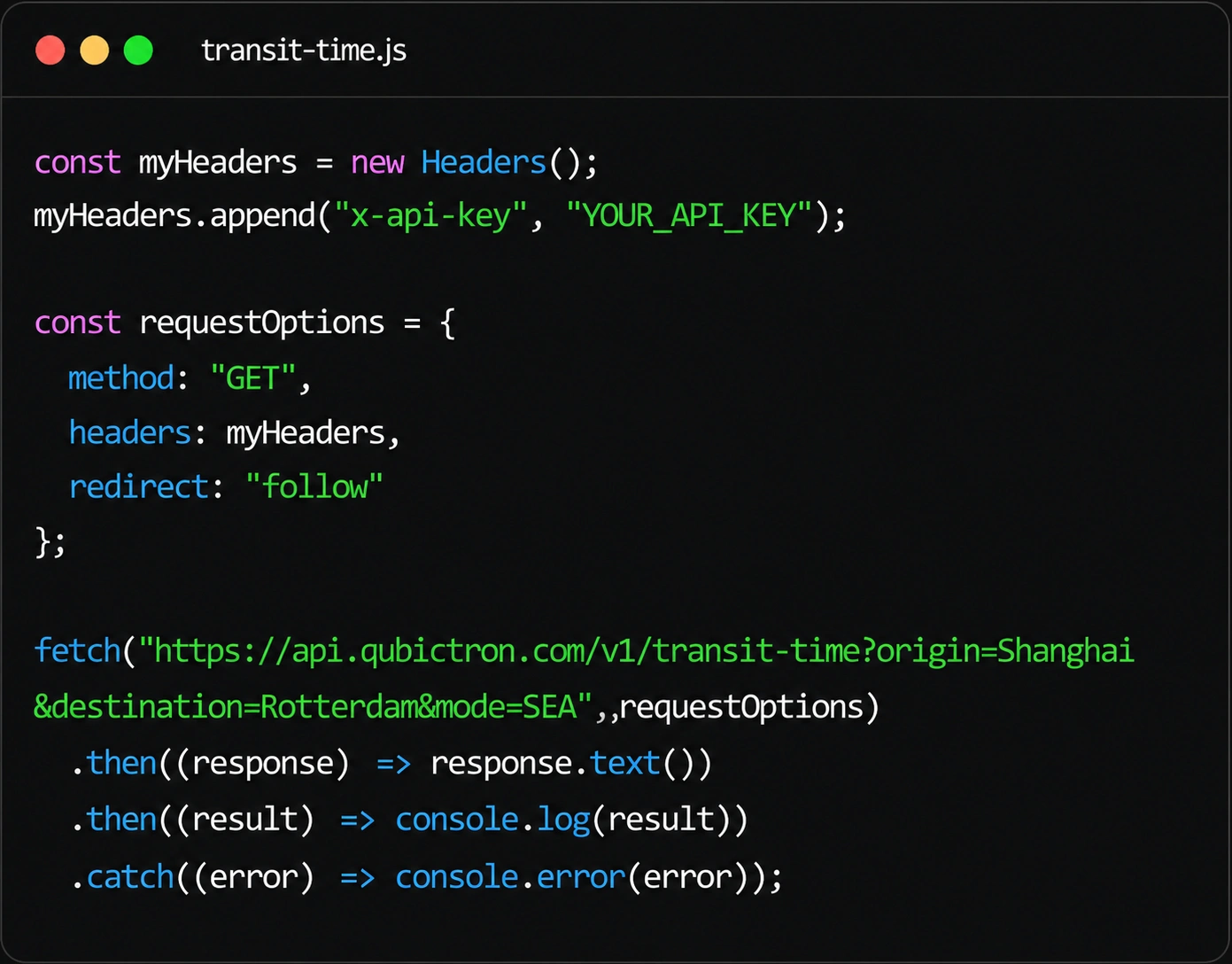
The Qubictron Transit Time API serves the same route-level estimates, drawn from 12M+ tracked containers across 200+ shipping lines.
Read about the API
FAQ
Transit time, answered
A published schedule is what the carrier plans. Actual transit time reflects what really happens once port congestion, vessel speed, and weather are factored in. Our estimates are built from that real movement history, so they tend to be closer to what you'll experience.
Sea distance is how far a vessel travels between two ports, measured in nautical miles (about 1.852 km each). It's the basis for estimating both transit time and fuel cost on a given route.
Yes. Beyond ocean legs, the tool covers road, rail, and air, so a multimodal route can be estimated end to end. LTL shipments can take longer than full truckloads since they share space and stops with other cargo. The estimate accounts for that.
Yes. The Transit Time API gives you the same route-level estimates as a JSON response, so a booking engine or CRM can quote a date without anyone opening this page.
Check a route
Get access to the calculator yourself, or bring the same data into your own platform.
Need it on your own site?
Pull the same transit time data into your platform with the API.
See the API